Discernment, [Re]considered
A complicated question gets the answer it deserves.

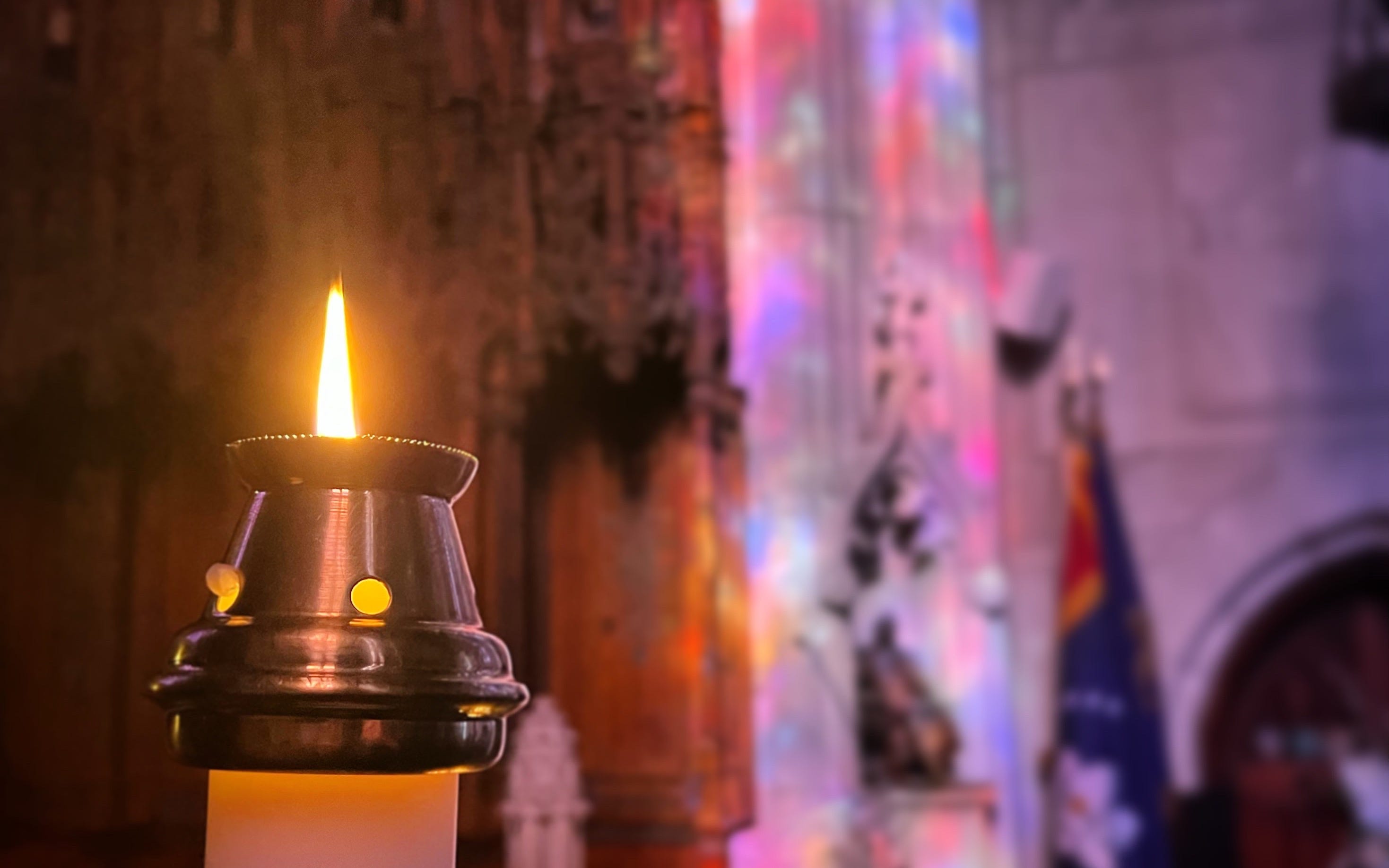
If I had a dollar for every time I’d been asked whether I’d considered discerning for the priesthood, I would by no means be a wealthy man. However, I would certainly be able to enjoy a nice dinner at my favorite Rittenhouse Square pub, funded by secular employees, laity, deacons, priests, and multiple members of the House of Bishops. Outwardly, it is a simple question, but one with complicated implications. Any simple answer that one could give deserves some explanation, which I would like to give here.
Talking about duty and obligation has become very unfashionable nowadays, as much in the Church as outside of it. And yet, there is a sense, largely unspoken, of what “Christian Duty” is, or should be. The first of Dr. Luther’s 95 Theses is: Our Lord and Master Jesus Christ, when He said Poenitentiam agite [Repent], willed that the whole life of believers should be repentance, and this theme echoes through the Church, heedless of denomination, to the present day. The “Way of Love” championed by our former Presiding Bishop is, at its core, a retooling1 of the Forward Movement’s “Disciple’s Way” of a century ago: TURN - FOLLOW - LEARN - PRAY - SERVE - WORSHIP - SHARE. The Catechism of the 1979 Book of Common Prayer, meanwhile, reminds us that penitence is but one kind of prayer, alongside adoration, praise, thanksgiving, oblation, intercession, and petition. Indeed, the whole life of believers is one centered in prayer - but encompassing all that flows into and issues forth from those prayers.
Where, then, does this leave the question of discernment? E. M. Green’s 1915 novella The Archbishop’s Test unconsciously spells out what this should mean:
“It may be that God is calling you. Take time for prayer and reflection. There is a three days’ retreat at Beaconsfield, beginning on the 14th. Go to it: it will be no expense to you, and I will see you on your return.”
“I do not know anything about a Retreat,” faltered the young man.
“It is merely keeping silence that the Voice of God may be heard. Go with this idea, and do not trouble yourself whether you are doing what the others are doing.”2
Keeping silence that the Voice of God may be heard! How easily our lives, in the second quarter of the twenty-first century, are swamped in busyness, chatter, and slop. It is no wonder that many people have doubtless missed sight of their vocations in the church, or neglected to consider how their service to the church is itself a vocation.
Shortly before Holy Week, an essay entitled “The Transitional Diaconate Is Not A Thing” was published by The Living Church. The author’s intent was to try to address the difference between those made deacons as their primary vocation, and those made deacons in the course of their preparation to being ordered priests; it engendered no small amount of commentary, and perhaps more heat than light. I would posit that much of this stems from the fact that we ourselves have been subsisting on a fairly impoverished understanding of what discernment is and who discernment is for.
When we think of “discernment,” we usually think of “The Process,” and that, usually, in an adversarial light. We think of the foolish fin-de-siecle fad of insisting on “life experience” which so ably stoked our present vocations crisis; we think of having to run a gauntlet through a Commission on Ministry incapable of looking beyond its own biases; we think of processes arbitrarily paused or stopped after significant time and treasure has already been expended; we think of the GOE gauntlet, and canonically-good answers being marked down because they challenge the examiner’s presumptions; we think of underqualified candidates being thrown into situations because of a perceived lack of diversity, and consequently humiliated. We think of nothing salutary. That we think so easily of these things is evidence of some sort of structural shortfall, and structural shortfall requires structural reform. I therefore propose the following:
The Christian Life is one of continual growth and continual discernment, no matter one’s station in the Church.
In the palmy days of postwar cultural Christianity, a great emphasis was placed on something called “baptismal ecclesiology.”3 Under the guise that Baptism is full and sufficient initiation into the Church (which is, indeed true), Confirmation in the 1979 Book of Common Prayer is reduced to an afterthought. This was a theological novelty; the English Convocations’ Joint Committees on Confirmation wrote, in 1944, that “Confirmation may be truly described as ‘the ordination of the laity.’ Those who receive it are ‘sealed’ and set apart for a lifelong vocation and ministry. This ministry consists in the exercise of that Christ-like activity of self-giving service, Godward and manward, which is implied as the outcome of their Baptism into the Body of Christ…. We must always remember that it is the whole Church and not the clergy only who have been made by Christ ‘a kingdom and priests unto God.’” 4 This was the prevailing prewar understanding, until the great postwar rupture swept it aside. Perhaps it is time that we more seriously reconsider it. Certainly, beyond the photographs, I remember nothing of my Baptism, having been about forty days old - but I remember well and fondly my confirmations into first the ELCA in secondary school, and then into The Episcopal Church after college. In both cases, Confirmation served as an opportunity for me to take up for myself the promises which my parents and sponsors had made over me in Baptism, and to take my place as an adult in the eyes of the Church,5 in the larger life of the Church.Discernment, beyond one’s own work of discernment, must begin within the life of the parish as a larger community. Every parish, in turn, must do its part to foster an atmosphere of discernment.
If the Body of Christ is indeed to be a source of mutual aid, comfort, and support to one another, we must be more candid about recognizing where vocations of all sorts might exist, and looking within or beyond ourselves to determine how best that our people might grow “into that state of life unto which it shall please God to call me.” How many of our parishes have raised up people to ordained ministry? How many of our parishes have raised up people to lay leadership in the local, regional, or national Church? How many of our parishes ring-fence these opportunities behind meeting times redolent of the Ladies’ Auxiliary of our parents’ youth?6 How do we, beyond engaging in box-ticking exercises, ascertain whether someone might be called to serve in these roles?
Discernment must be open-ended, and transparency of expectations and process must be prioritized.
For too many people, the priesthood is seen as the sole logical outcome of “a discernment process” of varying degrees of opacity. This is not always the case, and painting it as such sets up a postulant for failure or disappointment when it turns out that their gifts and graces might really be more truly aligned to the diaconate, or to lay service. The problem is that too many of our brains immediately short-circuit to “oh! a prospective priest!” when we encounter someone who knows the Prayer Book ju-u-u-ust a bit better than we do, or who can pray extempore a bit more eloquently than we can. That could just be a side effect of routinely praying the Daily Office (and how many of our parishes instruct their people in doing that?)
Lay vocations are vocations.
I was recently elected a deputy to the 82nd General Convention, having served as an alternate deputy to the last two. I am also the Secretary of Convention in my own Diocese, as well as a member of the Nominating Committee. In my home parish, having previously served two terms on the Vestry, I am a member of the board of our companion nonprofit, an acolyte, and a part-time member of the choir (a “noise” tenor).
I suppose it could be seen as vulgar to flare these credentials as if they were battle streamers in the wind - but no more so than some of the sartorial decisions made by bishops, priests, and deacons in mixed company! But, not having made vows of obedience to a bishop also allows one to operate with a degree of independence, which is particularly important in cases of potential misconduct. After all, when there is no hazard of censure, one can freely contact a bishop to ask just why half the contents of a cathedral’s silver vault have shown up on eBay. Several people in my varied orbits, perhaps most notably the late Louie Crew, have described the laity as “the oldest, and largest, order of ministry.” This is correct: the 1979 Catechism notes that the ministry of the laity is “to represent Christ and his Church; to bear witness to him wherever they may be; and, according to the gifts given them, to carry on Christ’s work of reconciliation in the world; and to take their place in the life, worship, and governance of the Church.”7The Diaconate, as a calling-unto-itself, could and should be more multifaceted than it now is.
In the pre-1979 Ordinal, the responsibilities of the Deacon are as follows:
To assist the Priest in worship, and especially the Holy Communion, and to assist in the distribution thereof;
To read Holy Scriptures and Homilies in the Church;
To instruct the youth in the Catechism;
In the absence of the Priest to baptize infants;
To preach, if admitted thereto by the Bishop;
To search for the sick, poor, and impotent people of the Parish, that they may be relieved with the alms of the Parishioners, or others.
These responsibilities are, by their nature, administrative, catechetical, and assistive: they answer practical, physical, and logistical needs. 1 Timothy indicates that a deacon should be able to manage their household; this, by extension, has been interpreted to mean that deacons in earlier eras of the Church were responsible for oversight of parishes, and particularly the books and funds thereof, on behalf of their bishops.
In the 1979 Ordinal, the responsibilities of the Deacon are as follows:To study the Holy Scriptures, to seek nourishment from them, and to model your life upon them.
To make Christ and his redemptive love known, by your word and example, to those among whom you live, and work, and worship.
To interpret to the Church the needs, concerns, and hopes of the world.
To assist the bishop and priests in public worship and in the ministration of God’s Word and Sacraments.
To carry out other duties assigned from time to time.
To show, in life and teaching, to Christ’s people that in serving the helpless they are serving Christ himself.
These responsibilities are - to be charitable - vague. My own experience has been that vague descriptions do not inspire confidence in prospective volunteers. Becoming a deacon requires significant outlay of time, and by modern custom, it is not compensated. Moreover, since all priests are also deacons, it seems a bit strange to not train both prospective priests and prospective deacons together in the things that affect them both.
Canon 7 of the Episcopal Church, Of the Life and Work of Deacons, is, for the most part, silent on the nature of the deacon’s ministry. The Catechism, however, states that the deacon “is to represent Christ and his Church, particularly as a servant of those in need; and to assist bishops and priests in the proclamation of the Gospel and the administration of the sacraments.”
Why should diaconal ministry take one dominant form when presbyteral ministry takes several? We all know of priests who serve in roles that aren’t Full-Time Parish Ministry™ - school chaplains, military chaplains, credentialed social workers, theologians, bivocational clergy, etc. There is a diversity of presbyteral ministry that should also be present in diaconal ministry, but is not. I suspect that this has to do with the specific nature of the modern understanding of the diaconate, coupled with the lack of compensation presenting a barrier of access and an unequal obligation: the ordained is obligated to the church, without the church being obligated to the ordained.8 Deacons are also assigned at the pleasure of the bishop, and usually away from the places that have raised them up. (And why should deacons be uprooted, and stationed elsewhere at the whim of bishops, when no such obligation binds presbyters or laypeople? This is unequal obligation in practice.)
My own understanding of the historical role of deacons is that they served in a function closest to that of a contemporary parish administrator, sexton, or facilities manager. (Which, let’s face it, a person turning up at your church and wanting to talk to the priest, for whatever reason, will probably encounter one of these people first.) If we thought of deacons in these roles, would we be as comfortable with treating them as unpaid labor?Perhaps we should reconsider how we situate diaconal ordination, the better to enshrine the diaconate as also being a vocation unto itself.
It is true that the terms “vocational diaconate” and “transitional diaconate” are imperfect. To date, I have encountered no good alternatives. What would it look like if, for example, we divided clerical formation, and placed diaconal ordination earlier within it? Perhaps it could fall prior to, or in the midst of, seminary education. Canon 7 permits significant leeway as to diaconal formation, “but no person shall be ordained a priest who has not served for at least six months as a deacon.” Would earlier diaconal ordination provide an honest off-ramp for someone who, mid-discernment, genuinely finds the fullness of their ministry to be in the diaconate? Would this structure be more beneficial to someone on a diaconal track who finds themselves more called to presbyteral ministry?
Cloaking exploitation in obscurantism and mysticism is a structural sin, and one for which the Church is being punished.
The Episcopal Church’s largesse stems, in no small part, from plantation-owners, robber barons, tycoons, and industrialists. Our legacy in the world of exploitation runs disturbingly deep. Viewed from the outside, the present discernment process, with its opacity and blatant, unacknowledged power imbalances, is certainly exploitative, and, I would argue, fundamentally indistinguishable from a hazing process - made that much worse by being cloaked in sacralizing or emotionalistic language and spoken of in that weirdly unnatural, LLM-y register best known as “discernmentspeak.”9 We know of people who could be fine priests or deacons, who simply could not make the economics of doing The Process work, or who have absolutely no appetite for the associated [malarkey]; we know of people who came out of seminary with stress-induced active addiction, relationship failures, lifelong medical issues, and other things which should never have been allowed to have happened.10 We need to be more candid and more transparent about what The Process is, how The Process works, how its oversight works, and what the outcomes may be. Pious platitudinarianism may warm the heart, but it will not fill the stomach.
When Green’s fictional Archbishop of Canterbury receives at luncheon the young man whom he sent to Beaconsfield for that retreat, there has been a change.
“…[W]hen the young man came back there was a steadfastness in his face not known before.
“I have learnt so much,” he said quietly, “but now, though I know my unworthiness more than I did before, I hope I may one day be His minister. I can’t get those words out of my head: ‘For they are the sheep of Christ, which he bought with His death, and for whom He shed His Blood.’11 I would like to help if I might, only I have so much to learn.”
“God bless you,” said the Archbishop gently. “Now we will talk.”
In reducing discernment to just the pursuit of Holy Orders, we impoverish our understanding of discernment, and we impoverish our Church. Let a culture of discernment take root among us, and flourish, and let us meet the challenges of the second quarter of the twenty-first century with fortitude and aplomb.
So, have I considered discernment?
Yes. And, at this time, I believe that I have responded to Christ’s call to serve His Church to the best of my understanding, in the lay order.
Will that answer always be the same?
Only God knows.
The “Way of Love” has TURN - LEARN - PRAY - WORSHIP - BLESS - GO - REST, plus an unfortunate proliferation of Eric Gill typefaces.
Green, Emma Martha. 1915. The Archbishop’s Test. p. 76
Although a majority of Episcopalians now alive were also alive when the 1979 Prayer Book was implemented, I have never gotten a straight answer as to just what this means. It is very curious that this concept is cherished so fondly by people who were baptized and/or confirmed under the older rite.
Confirmation To-day, being the Schedule attached to the Interim Reports of the Joint Committees on Confirmation setting forth certain major issues before the Church, as presented to the Convocations of Canterbury and York in October, 1944 (London: Press and Publications Board of the Church Assembly, 1944), pp. 11, 13: paras 15-16, 18.
Except in the present-day Episcopal Church, where I, halfway through my Biblical threescore-and-ten, am still - inexplicably - considered a “young adult.”
A parish outreach committee was becoming increasingly desperate for new members, as its youngest members were septuagenarians. It was the custom of the outreach committee to hold its work sessions at 1:30 on Tuesday afternoon.
‘79 BCP p. 855
The 81st General Convention did pass Resolution 2024-A135, calling for all nonstipendiary clergy to be paid a minimum of $25/month in order to allow them to receive Church Pension Fund benefits. We consider this to be a step in the right direction.
Which I interpret to be something in the nature of a cry for help. Per Bl. Adrian Fortescue: Imagine talking like this!
I am familiar of several incidents of this nature, most of which had to do with the relative isolation of a certain seminary in Province IV and the total lack of viable employment opportunities for the non-discerning partner.
This is taken from the Exhortation from the old Form for Ordering Priests. Its excision from the 1979 Prayer Book is an inexplicable and devastating loss. I wholeheartedly encourage anyone pondering Holy Orders to read, mark, learn, and inwardly digest it with the greatest of care. Take it to heart.